
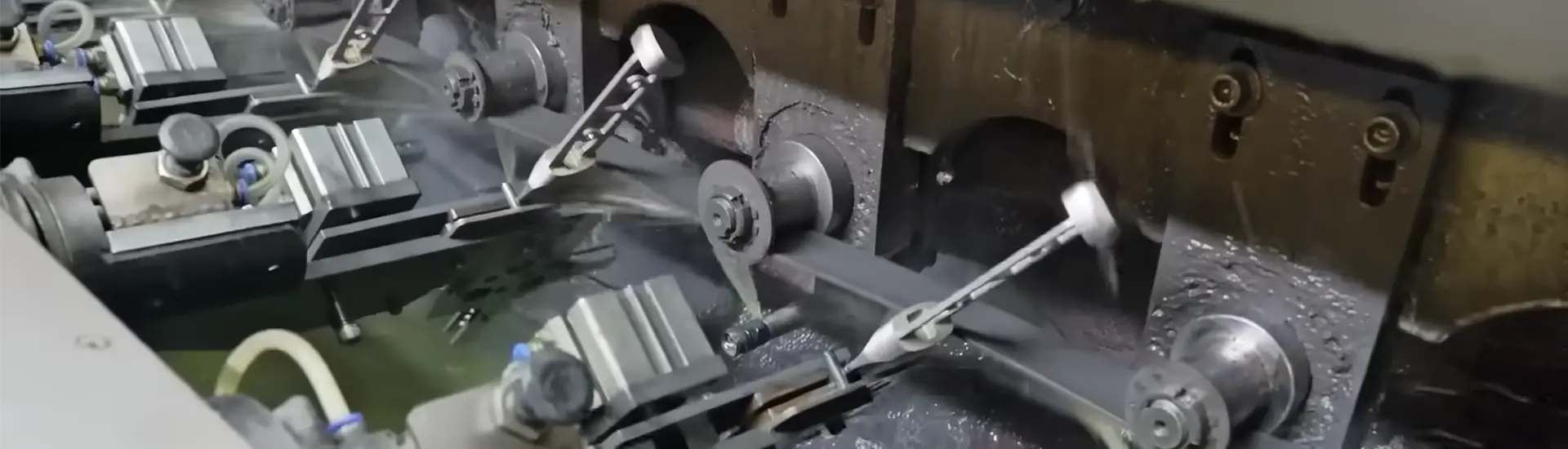
Last year, a European OEM brand owner contacted our Shanghai export desk after their Chinese supplier’s stainless steel plastering trowels arrived with unpredictable blade flex—some so stiff they snapped at the first tap, others bending permanently under normal troweling pressure. The root cause turned out to be mid-batch grinding drift during taper grinding, a failure that had gone unnoticed because the supplier relied on a network of small subcontract workshops with no unified process control. From our Zhejiang factory, we recognized the pattern immediately: inconsistent taper geometry, not merely variable steel hardness, was the hidden trigger. For enterprise buyers who depend on container-level volumes of professional plastering trowels, such drift threatens brand integrity, warranty claims, and project timelines.
Why Mid-Batch Grinding Drift Is a Symptom of China’s Multi-Supplier Trowel Trade
In many Chinese trowel supply chains, what appears as a single supplier is actually a constellation of small workshops. The trading company aggregates orders, but does not control the grinding process. Each batch may be produced on different equipment, with different set-ups, and with minimal in-process inspection. When a trowel blade is taper-ground—thinning progressively from the heel to the working edge to achieve a specific flex profile—even a few microns of deviation in the grinding wheel’s travel or pressure can alter the blade’s stiffness dramatically. The result is the flexibility drift you experienced: some trowels in a single container are effectively a different product than others. To understand the difference that direct manufacturing makes, let’s compare a dedicated Zhejiang factory’s process with the typical trading-company approach for stainless steel plastering trowels.| Aspect | Direct Zhejiang Manufacturer (Trumax) | Typical Chinese Trading Company Supplier |
|---|---|---|
| Grinding Process Ownership | In-house taper grinding on dedicated production lines with standardized tooling and regular calibration | Outsourced to multiple workshops with no unified SOP; grinding machines may differ in age and precision |
| Quality Consistency | Consistent blade flexibility verified by in-process gauging and post-grind lot testing | High within-batch variability; flexibility can drift between sub-lots without detection until delivery |
| On-Site Audit Access | Full factory floor access at our Zhejiang base; clients can witness grinding, hardness testing, and packing | Often shows a rented showroom or a partner factory; true production sites remain hidden |
| Documentation & Traceability | Lot-linked grinding records, material certificates, and QC reports tied to each container | Generic or missing documentation; no clear linkage between a specific trowel and its production batch |
| Flexibility Drift Prevention | Multi-point check during grinding plus post-grind classification for stiff vs. flexible models | No dedicated flexibility test; trowels are shipped as-grind, regardless of actual performance |
How Our Zhejiang Factory Controls Taper Grinding to Guarantee Consistent Flexibility Across Batches
At our Zhejiang manufacturing base, we treat taper grinding as a precision engineering process, not a rough shaping step. The following in-house controls eliminate the drift that plagues multi-supplier sourcing.1. In-Process Taper Grinding with Real-Time Checks
Our grinding stations are set up to maintain the exact taper angle and material removal rate required for each trowel model. Operators perform frequent spot checks with profile gauges, comparing the blade thickness at multiple points along the working length. Any deviation triggers immediate correction—no batch ever runs to completion without verification. This ensures that a 30,000-unit run of flexible plastering trowels has the same flex profile from the first piece to the last.2. Post-Grind Flexibility Classification and Hardness Verification
After grinding, every lot undergoes a flexibility test under a standard load. Trowels are automatically sorted into predefined flex bands—stiff, medium, flexible—matching the OEM specification. Simultaneously, we perform in-house hardness testing on sample pieces to confirm consistent material properties, although we have learned that flex drift is far more sensitive to geometry than to hardness alone (see Part 4). Classified trowels are then packaged separately, so a client ordering “flexible stainless steel plastering trowels” never receives a mixed batch.3. Complete Traceability from Coil to Container
Each manufacturing order is assigned a unique lot code that follows the trowels from raw stainless steel sheet through stamping, grinding, assembly, and final inspection. Lot-specific documentation includes grinding set-up records, flexibility test summaries, and visual inspection sign-offs. For OEM private label clients, we can include a printout inside the carton and forward the digital quality dossier prior to FOB Shanghai shipment.
Why Taper Grind Geometry, Not Just Blade Hardness, Determines Trowel Flexibility
A common misconception is that flexibility drift stems from poor steel quality or inconsistent heat treatment. In our experience, while material hardness matters for edge durability, the greatest sensitivity lies in taper grind geometry. The cross-sectional thickness profile of a stainless steel plastering trowel—how quickly it thins from the handle-mount area to the tip—largely controls the bending stiffness. A trowel ground with a slightly steeper taper will feel dramatically softer, even if both pieces share the same HRC range and identical chemical composition. When a grinding wheel’s dressing interval stretches too long, or a small workshop swaps operators mid-batch without resetting the depth-of-cut, the effective taper changes. That is the mechanism behind the “mid-batch drift” your previous supplier could not explain. Our Zhejiang factory mitigates this risk through frequent grinding wheel dressingDiscuss Your Manufacturing Project
Email your drawings or questions. We reply within 24 hours.